
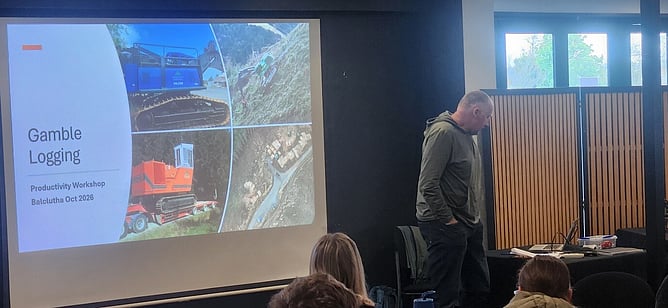
Over the past several months, FICA, in partnership with the University of Canterbury's Forestry School, has delivered a series of productivity workshops in Rotorua, Nelson and Balclutha, culminating in a post-HarvestTech workshop on 11 November.
The workshops were established to address one of the forestry sector's most important challenges: how to improve productivity while maintaining the industry's strong focus on safety, sustainability and business viability.
A recurring theme throughout the series was the significant investment the harvesting sector has made in mechanisation over the past decade. While modern harvesting systems have delivered substantial safety and operational benefits, they have also increased the level of capital and debt required to operate successful contracting businesses.
Findings from FICA's Annual Financial Health Survey highlighted the financial pressures many contractors continue to face, including rising costs, growing debt burdens and tightening margins.
The final workshop drew on lessons from the recent OneFortyOne windblow recovery operations. Presented under the theme "Never Waste a Good Crisis", the session examined how the industry responded when faced with a significant operational challenge and what productivity lessons could be carried forward into normal harvesting operations.
Industry panellists Sam Nuske, Nathan Taylor, Mike Fraser, Steve Borlase and Ian Leslie shared practical insights from the response.
Discussion centred on how flexibility, innovation, planning, data and strong collaboration across contractors, forest managers and supply chain partners helped unlock productivity gains in a high-pressure environment.
One of the strongest messages to emerge from all three workshops was that productivity is not solely a contractor issue. Performance outcomes are influenced by decisions made throughout the forestry supply chain. Improving productivity requires collaboration between contractors, forest owners, forest managers, transport operators, equipment suppliers and researchers.
Participants also discussed the importance of benchmarking, operational measurement, costing analysis and the sharing of practical experiences across the industry. Small improvements in planning, machine utilisation and communication can collectively deliver significant gains in performance and profitability.
The workshop series demonstrated the value of bringing research and practical experience together to tackle common industry challenges. As forestry continues to face increasing cost pressures and capital requirements, the need to lift productivity has never been greater.
The industry's future success will depend not only on continued investment in technology, but also on a willingness to collaborate, challenge traditional thinking and learn from both everyday operations and times of crisis.