
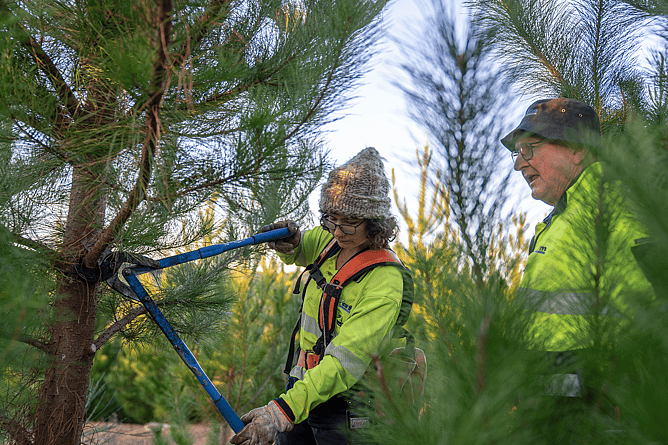
New Zealand's forestry sector has confirmed it will align its workplace vocational training with the new Engineering and Manufacturing Private Training Establishment (PTE), operating under Competenz.
The decision follows extensive consultation with employers, contractors and training providers, led by the New Zealand Forest Owners Association (NZFOA) and Forest Industry Contractors Association (FICA) joint Forestry Training Committee (FTC).
The NZFOA and FICA have endorsed the move, saying it provides the strongest platform to maintain consistent, industry-led training across silviculture, harvesting, engineering and forest management while improving long-term capability.
"This is about ensuring forestry continues to have a training system designed by industry, for industry," says Forestry Training Committee Chair, Kevin Ihaka.
"Our employers invest heavily in training because they know a skilled workforce is essential for safe, productive and sustainable forestry operations. This arrangement gives the sector greater influence over how that training evolves in future."
Forestry is New Zealand's fourth-largest primary export earner, directly employing more than 8500 people. Over 90 percent of the workforce participates in formal training, with the vast majority of learning taking place on the job.
Following consultation with more than 200 industry participants, employers, contractors and training providers, the FTC developed a clear set of requirements for any future training provider.
These included strong industry input into decision-making, transparency around investment in forestry training, continuity of existing capability and minimal disruption for learners and employers.
"In assessing potential training providers against these requirements, the proposed primary industry Private Training Establishment (PTE) was initially preferred, but after engaging with the Competenz Board and leadership team, it became clear that Competenz’s Engineering and Manufacturing PTE would be better suited to forestry’s training needs," says Kevin.
Under the new arrangement, forestry will have:
A dedicated forestry team with its own cost centre
Retention of forestry programmes, systems, staff capability and intellectual property
Continued access to the national network of forestry trainers and assessors
Forestry participation in ownership through a shareholder arrangement
A formal forestry Board seat, with candidates assessed against a skills matrix
A Head of Forestry role within the senior leadership team
Structured industry input through the FTC, which will act as the industry's advisory group to both the Forestry Team and the PTE Board
Transparency over financial performance and investment decisions.
"Industry told us it wanted stronger influence, greater accountability and continuity for learners and employers. We believe this model delivers on those priorities while creating opportunities to modernise training delivery over time," Kevin says.
Higher-level forestry qualifications, including diplomas, university degrees and other tertiary programmes, will continue to be delivered by existing universities, polytechnics, wānanga and other PTEs.
The FTC will now work with Competenz, the Food and Fibre Industry Skills Board and industry stakeholders to support implementation. An online briefing for industry will be held in early August to outline the transition process and next steps.