When I got a call from CWCWC (Canterbury West Coast Wood Council) Chair Glen Moir, inviting me to present at the CWCWC members’ event, I didn’t need much convincing.
I had looked at the National Exotic Forest Description (NEFD) for the region, so I was aware that wood supply had peaked and is now contracting quite rapidly. For contractors, that means less certainty of work, more competition for what is available, and real challenges maintaining crews and utilisation.
At the same time, that reduction in supply flows through to processors, creating underutilised capacity and higher costs. Add to this cost inflation and the fuel crisis, and you potentially have a very challenging operating environment.
Simon Brand (Brand Logging) picked me up and we headed north to Hanmer to see Kerry Gavin (Gavin’s Logging) who run a couple of mechanised ground-based operations in the Hanmer region. In recent months, they’d been tidying up windblow in Hanmer Forest for Matariki, who Kerry says is a very good, professional company to work with, and that the relationship goes back many years. We discussed the declining cut, which is a concern. They are currently completing a long-term contract, and next year they will have to retender for their work with Matariki.
We then briefly visited one of Brand Logging’s small windblow salvage operations in Hanmer’s Heritage Forest. Established in 1901, it’s a significant natural area in New Zealand, planted with a mix of native and exotic trees to test their performance here. Brand Logging is doing a great job of tidying it up following weather damage, working closely with Matariki and other stakeholders.
Brand Logging has been a long-term member of FICA, and Tony served on the Board for a number of years. Brand Logging is also a CWCWC member and a strong supporter of the University of Canterbury School of Forestry, having assisted with a number of research projects.
We caught up with Steve Norris from Allan Laurie Forestry, a very well-established and respected forest management company. They operate more in the woodlot and private forestry space and Steve was pretty upbeat about the industry. The challenge when operating in woodlots is putting sufficient forward work in front of contractors so they have the confidence to invest in machinery and people. The fuel crisis has been challenging, but they have worked collaboratively with forest owners, contractors and wood buyers to continue operating.
We headed out to meet harvesting contractor Matt Monro, who comes from a civil engineering background, and found his way into forestry initially through building roads and skids, then harvesting, and later adding a couple of log trucks. He still uses civil work to support his forestry business and, as he says, diversification is key.
My final visit was to the husband-and-wife team of Baden and Pam Ryan, of Ryan Earthworks. With just three machines and two operators, Baden has significant experience in forest operations, including earthworks and harvesting. The configuration of the crew seemed perfect for the type of work they were doing, which required a lighter footprint, lower capital and operating costs, and lower production.
Onward to the CWCWC members’ function in Christchurch, where they have a very broad representation across the supply chain. I spoke about the current state of play from a contractor’s perspective and highlighted the considerable capital investment made by typically small, family-owned businesses since 2013 to improve health and safety performance and productivity, the challenge of continuing to achieve productivity gains to offset costs, and the creep in regulation, particularly following Cyclone Gabrielle. I also acknowledged the strong level of representation and collaboration between different stakeholders in the Canterbury supply chain.
I had the opportunity to catch up with John Hawkins, of Stoneyhurst Timbers, and reminisce about my days in wood processing. To future-proof their log supply, Stoneyhurst is now one of the largest private forest owners in Canterbury and has very strong relationships with forest managers.
The following day I was picked up by Corban Liley, Harvest and Training Manager at Forest Management Group (FMG), and we headed out to catch up with Alan Nicholls, of Davaar Logging.
Davaar is a long-time FICA member and runs a single, fully mechanised ground-based crew. They operate in private forests, so the numbers have to add up for the forest owner to ensure there is continuity of work for them. They have just upgraded their feller buncher, which was a difficult decision in the current environment, when the cost of new gear seems to have ramped up.
With the latest fuel crisis, everyone has had to work together to keep things going. Davaar works very closely with FMG to ensure continuity of work. Some of the terrain they work on is pretty challenging, and they are considering purchasing a winch, another difficult decision in the current environment. Alan has his succession plan sorted, with his son Simon actively involved in the business.
We then headed back to Christchurch, so I could catch up with Rien Visser at the School of Forestry. Rien introduced me to a number of his staff, including Jeanette Allen, Senior School Coordinator.
It was a great couple of days. Thanks to everyone involved from inviting me, to driving me around and allowing me to visit. The only negative was the Chiefs v Crusaders game playing as I flew home. I touched down to discover we had lost, however Simon was gracious in victory, which is unusual for a Cantabrian.
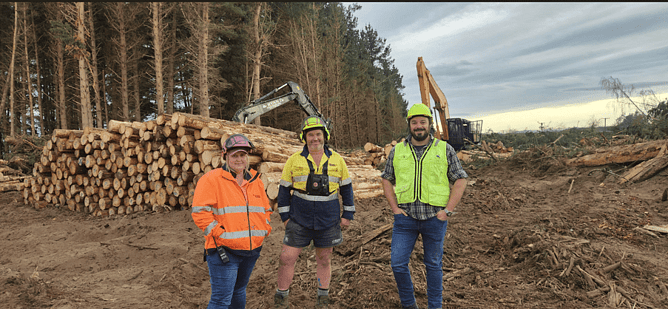
Pam, Baden and Steve
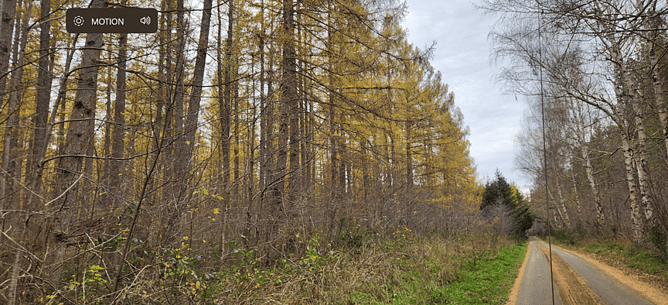
Larch Heritage Forest
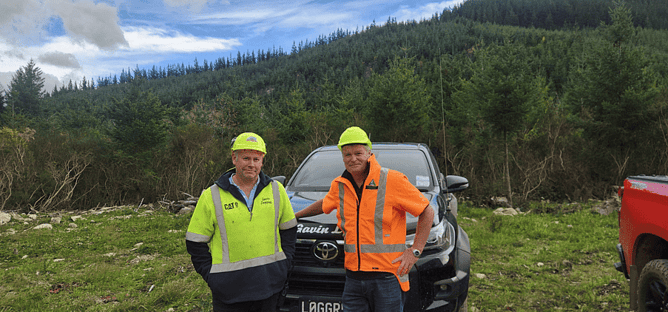
Kerry and Rowan
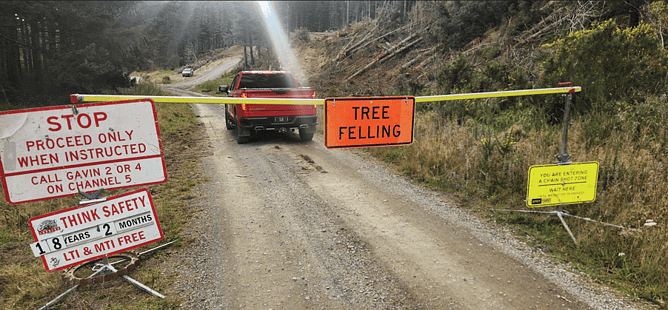
Gavins Logging and Simon Brand’s red Chev
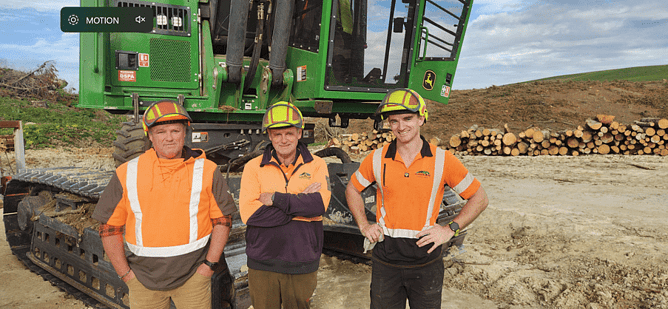
Corban, Alan, Simon and their new 909