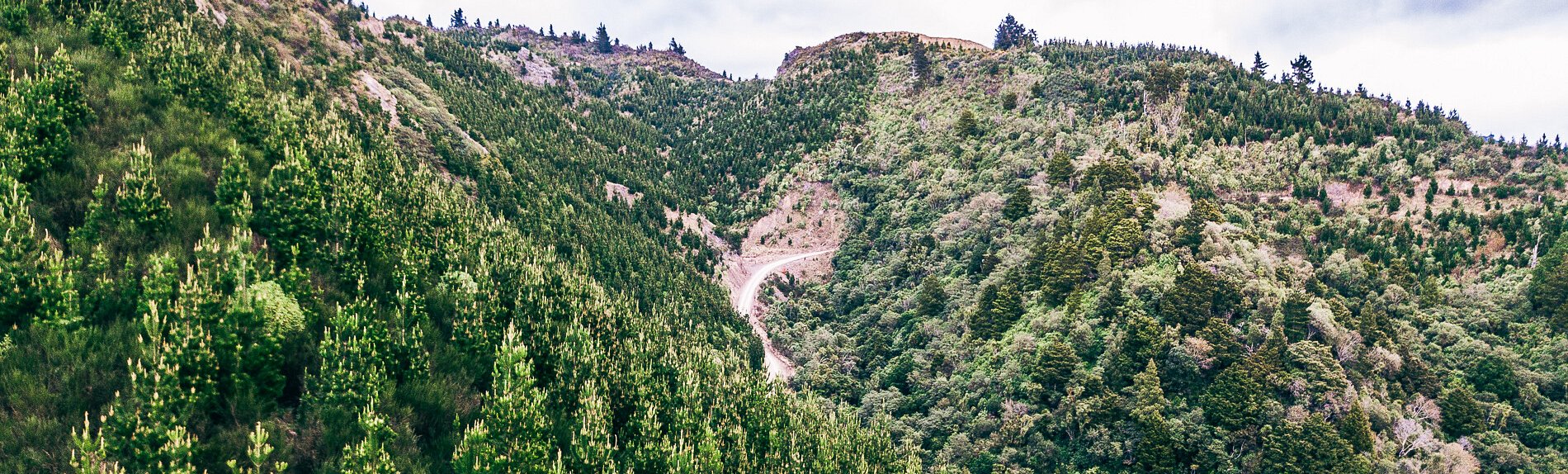
If you’re in Northland, you’ve probably heard the name Peter Davies-Colley (The Tree People) mentioned more than once or twice. Passionate about Northland and Forestry, Peter is a member of NZFFA and a recent appointment to the FGLT Board. He also rejoined as a FICA member in 2024 after a hiatus.
I have a long-standing connection with the region, having spent five years in Northland earlier in my career. While based in Auckland, Peter’s younger brother Tony was once my biggest competitor in the lumber market—before later becoming my largest supplier. As the saying goes, in New Zealand there is often just one degree of separation.
It is fantastic to have Peter back with FICA. He represents an important segment of the industry—the private, non-corporate sector—where FICA has opportunities to strengthen its representation. Peter brings a valuable combination of insight, innovation, and hands-on experience. Interestingly, I also discovered he was one of PFP’s first clients.
Contractors operating in this part of the industry face unique challenges, so I was keen to visit Peter’s operation and see his work firsthand. After attending a FICA Board meeting in Whangārei, I travelled out to his site in the backblocks. Peter greeted me at the gate—appropriately, in his electric car.
As we drove up the property, I noticed a sign instructing all log trucks to adjust their tyre pressure before entry. Despite recent rain, the driveway was in excellent condition and comfortably supported the operation’s throughput of eight loads per day.
Cartage was managed by Ian Newy, a contractor I had previously worked with. Ian had recently purchased Ken Holmes’ Northland business. Coincidentally, I had caught up with Ken over coffee the day before—our connection dating back to our first meeting in Murupara in 1992.
Peter was harvesting a six-hectare steep, ground-based block owned by Ian Page—whose credentials include researcher, forester, contractor, consultant, and conservationist. You couldn’t ask for a more qualified client to assess harvesting performance. Peter is obviously meeting the mark as the current stand is one of a number of stands on Ian’s property that Peter has harvested.
Peter’s approach is focused on minimising environmental footprint by reducing machine size, limiting infrastructure development, and maintaining a low-cost operation—resulting in less site disturbance, lower fuel consumption, and improved efficiency. He took particular pride in showing me former processing and load-out sites that were now virtually indistinguishable from surrounding pasture.
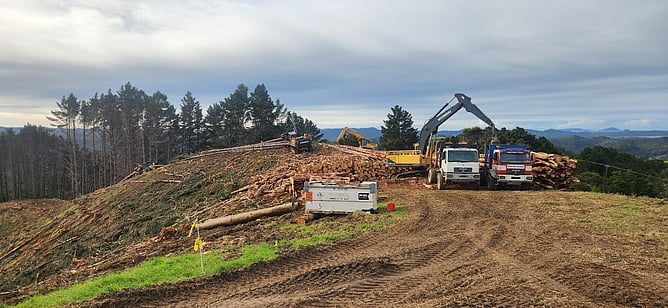
On the day of the visit, the operation included a feller-buncher running on a tether (T-winch 10.2), undertaking felling, uphill shovelling, and bunching. A grapple skidder hauled the logs uphill (operating without a tether, though a second T-winch 10.3 was available) to a processor located on an unformed skid site within the cutover. The processor cut three main grades directly into bunks with an additional 12 cuts to maximise value recovery.
Two staging was carried out using modified MAN trucks (converted fertiliser spreaders), which staged timber for transport approximately 500 metres along an unmodified farm race. These trucks were equipped with air-operated chains to secure the loads effectively.
While I’m no technical expert, it was clear that both the equipment and crew were well matched to Peter’s objectives and operating conditions.
However, as is often the case in this sector, contractors don’t have the luxury of waiting for market conditions to improve. The introduction of fixed pricing by some exporters has helped reduce market volatility and provides greater certainty—allowing contractors to start and finish harvesting blocks with more confidence.
At the time of writing, Peter did not have another harvesting block lined up, noting that current returns are not sufficient for landowners. He will find alternative work to keep his team busy for the next month, sustained cost pressures—particularly around fuel—will be challenging but he will get by as he always has, ready for the next upswing.
Let’s hope market conditions improve soon.
Thank you, Peter, for an insightful and thoroughly enjoyable visit.