
Unfortunately, the day I visited Nelson, harvesting operations had been curtailed due to constraints on the supply chain. However, we decided it was a beautiful day and we thought we would go for a drive.
Nathan, Director of Mechanised Cable Harvesting (MCH) and FICA Board member, picked me up at 7:40.
I first met Nathan back in 2013, when Ken Holmes and I made a deliberate visit to Ross Wood’s operation during a period of major reckoning for the industry. It was increasingly clear that the status quo in tree felling could not continue.
That visit became a defining moment, reinforcing the case for mechanised, winch‑assisted harvesting and helping catalyse a shift in how steep‑terrain forestry is approached—locally and around the world.
Nathan was the first of a number of Ross’ prodigies I was to meet in my forestry career, they are littered throughout Forestry operations in NZ, yes, even Wayne Henman.
To this day, I still very vividly remember Hamish Matthews (now Mathews Cable Harvesting) disappearing over the side of the skid in an excavator on a 40 degree slope tethered to a bulldozer. Both Nathan and Hamish followed in Ross’ foot-steps and both run their own highly productive logging operations, still pushing the boundaries.
If you get the opportunity to talk to Nathan sometime about how he uses STICKS to manage productivity in his operation, make it a priority as it is time well spent.
We caught up with Kim Byant (Nigel Bryant Ltd) in Richmond for breakfast. Bryant have recently rejoined as FICA members after leaving in 2017. Bryant are one of the largest contracting businesses in Tasman/Marlborough running ten harvesting crews.
Kim says the reason they’ve rejoined FICA is he believes our advocacy is hitting the right spot and contractors need a voice. After Nathan ate his VIP helping of bacon, we headed for the hills and met up with Matt Pearless of Pearless Silviculture. Matt provides silviculture services to One Forty One that includes chainsaw thinning, poison thinning, planting, manual tree falling and other miscellaneous services including rural fire.
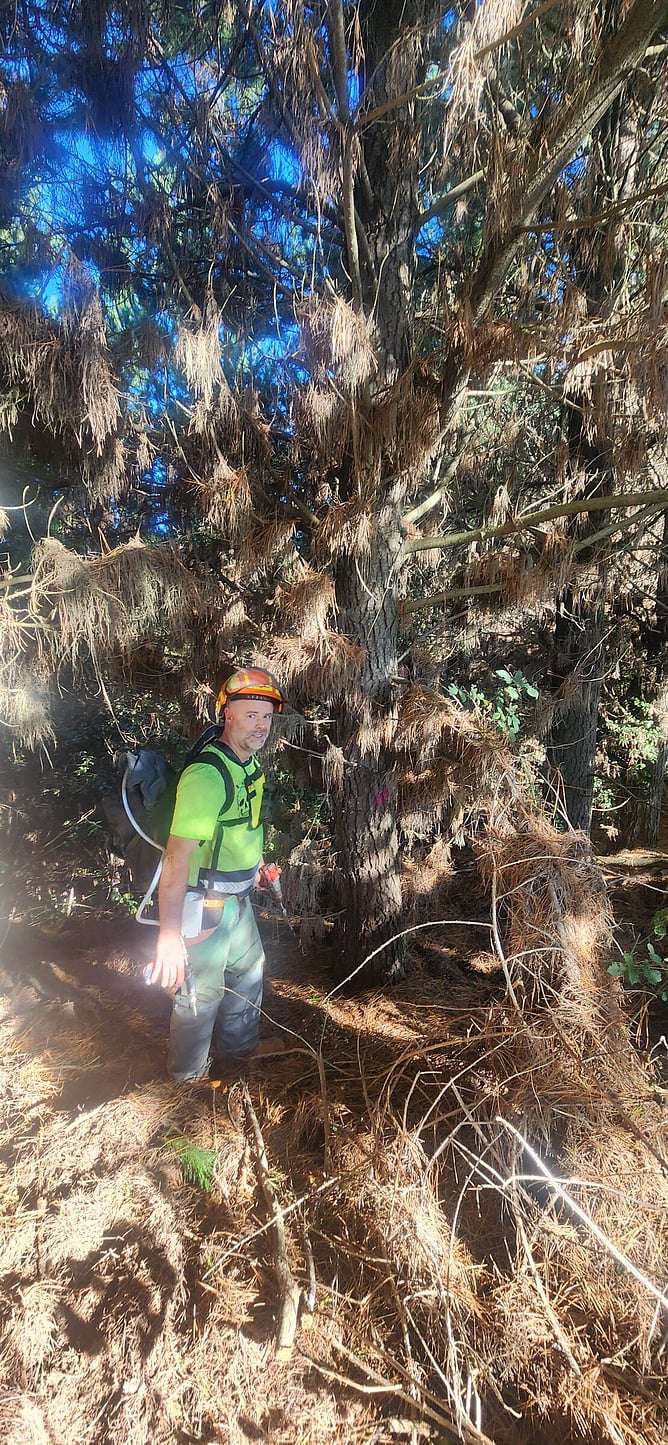
Having never seen poison thinning before, I was keen to get amongst the trees and have a look. The stand of trees was 15 years of age, standing well over 800 sph, and well over 12 metres tall. Having done a bit of 'thin to waste' as they used to call it, I could only imagine how difficult it would have been to get these trees on the ground with a saw.
The poisoning makes it simple; it’s quiet (we had a weka who joined us) and I’m told it reduces windblow in late thinned stands, which was a segway into the next part of my day.I’m not too sure if was the quality of my conversation with Matt or Nathan’s strong arm tactics, but Matt has signed up to become one of FICA’s newest members. It’s great to have a new silviculture contractor on board. Matt is passionate about rural fire and I have connected him up with Kevin Ihaka (Northland’s fire guru).
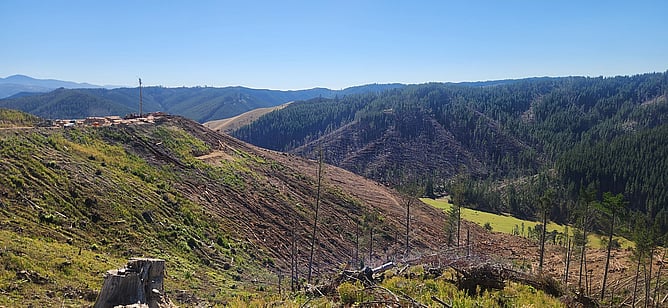
We then headed to Boar Logging (Nigel Bryant Ltd). This is when I started to get a feel for the magnitude of the windblow in Golden Downs, some of it is messy (like pick-up sticks) but some of it looks like it’s been laid down by some huge mechanical arm. Boar were one of the few crews working that day because they supply a heavy mix of domestic grades that were still moving.
By coincidence, local legend Nigel Bryant happened to be on the job, so it was a good opportunity for me to finally meet him. He is on to his third rotation harvesting in Golden Downs. There are not too many loggers in the world that can claim that.
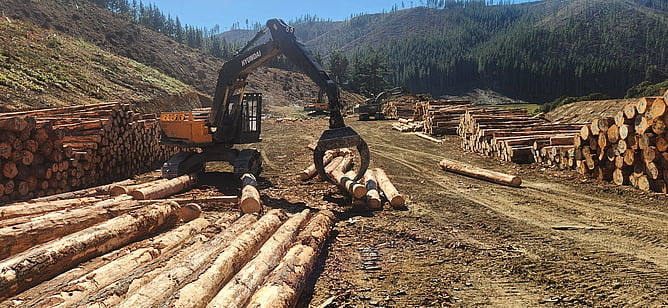
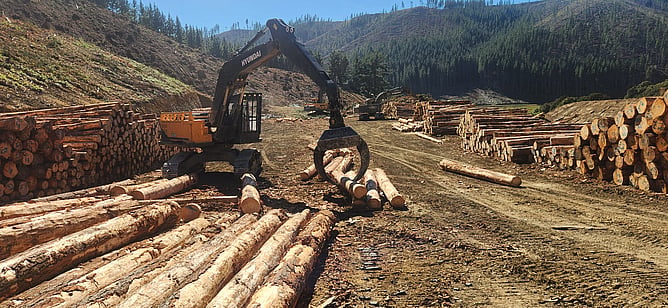
There was a Duxson bunching grapple working on the skid. FICA is currently doing some work for LTSC on the rules surrounding the use of bunching grapples for trailer lifting. It was a good opportunity to see the grapple in use.
We then toured around other parts of Golden Downs, and there was windblow everywhere. We drove past a number of crews with machinery parked up, maintenance vehicles and engineers taking the opportunity to do maintenance.
The day I visited was one of the few where operations have had to be parked up, all agreed generally the logs have flowed well through the supply chain with record volumes being shipped each month. It’s a really good example of how necessity becomes the mother of invention. Good progress is being made, apparently the region is 40% of the way through the windblow, and it will keep contractors busy into 2027.
It was a very enjoyable day and a reminder to me that I need to spend less time behind a computer and more time out in the field in the regions engaging with our contractors. Thanks to Nathan and those that put some time aside to talk to me.