
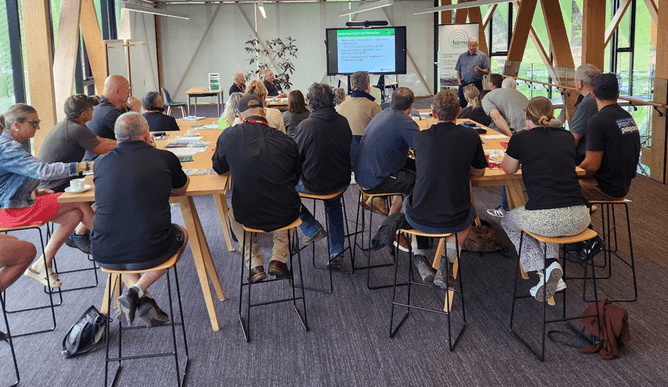
On the back of a successful pilot FICA Costing Workshop in Gisborne, a second workshop was run 12 November in Rotorua. Presented by John Schrider and Kevin Reardon (Forme Group) and Mark Blackburne (Blackburne Group), the three have combined industry experience of over 100 years.
There was a good mix of contractors and forest managers, with some good open and robust discussion. FICA acknowledges the support from forest managers; it is important that the whole of industry has a fundamental understanding of costing principles.
As we all know, costs have increased dramatically since 2020 (see graph below), noting PPI inputs (cost of production) does not incorporate wages and salary or capital expenditure.
If wages and capital cost were included, the difference between input and output costs would be more significant. Noting also the capital cost component makes up circa 30% of crew costings or excluding interest in the low 20s.
Further work is currently being done by Forme to understand the rate of capital cost increases versus CPI; the belief is capital costs have increased a higher rate.
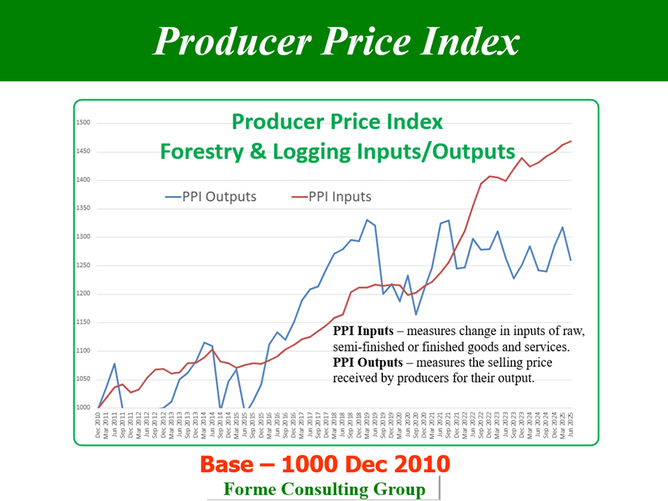
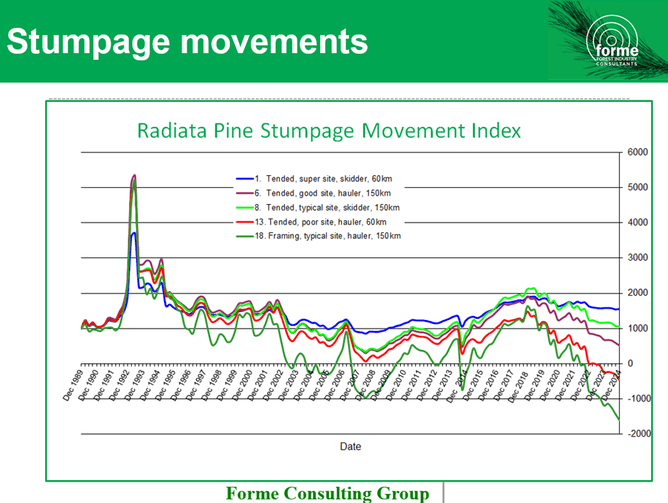
The disparity between inputs/costs and outputs is putting real margin pressure on both Forest owners and contractors. The chart below shows the impact on stumpage movements.
The feedback from the workshop was overwhelmingly positive with all who responded saying they would recommend it to others.
It was and is acknowledged that understanding costs is an important and first step in addressing the current state of the industry. When asked what additional topics need to be covered, FICA had the following responses:
‘Productivity but I suppose that is another whole workshop’
‘The effect of contract terms i.e. a 2-year contract vs a 5-year contract and how they may or may not effect day costings’
These questions are a segway into looking at the whole picture, not just costs. They include the level of contractor’s debt, the cost of servicing this debt, succession planning of contractors, length of contracts (visibility/security), machinery prices, machine utilisation and productivity.
These challenges can only be resolved through collaboration between contractors and forest owners to address the whole picture.
The first step in this is to quantify what the current financial health of contractors is. FICA plans to run a financial health survey of contractors in January 2026. It is envisaged that a further workshop will follow, with forward thinking contractors and forest managers getting around the table to tackle these challenges.
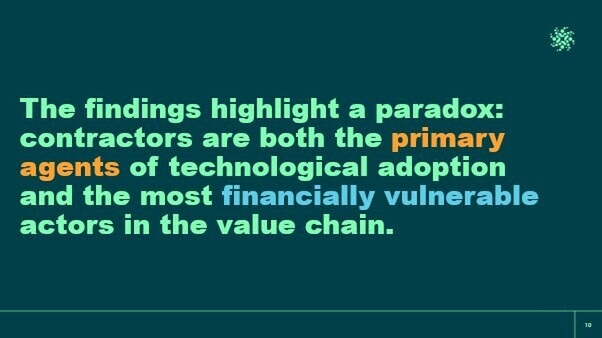
Thanks to SCION (New Zealand Institute for Bioeconomy Science (BIS) from 1 July 2025) for providing the venue. As koha for the use of the venue Oscar Montes from BIS made an informative presentation that tied in nicely with the workshop. His first slide reinforced the opening slides in the costing workshop that set the scene for the day. Yes, it’s sobering but unless we as an industry acknowledge we have a problem it’s difficult to come up with a solution.

Oscar also shared data derived from an industry survey (Forest Owners and Contractors) looking at technology adoption and a workshop on different business/contracting models. The slide below summarises the current situation regarding technological adoption.
Both the workshop presentation on costing and Oscar’s presentation can be found here.
It should be noted that the presentations themselves don’t capture some of the real benefits of being at the workshop in person. When participants were asked, ‘What did you like best?” participants responded:
‘I particularly enjoyed the accounting aspect of the costing discussions shaped by Mark’
‘tips and tricks about where and how to make and save money, the open chat and shared examples’
The workshop was finished off with Kevin giving a demonstration on the recently developed Forme costing App. It is based on the Forme Costing book but has the functionality to change all variables so you can see impact/sensitivity of these changes on daily costs. [KG1]
Participants were also reacquainted with the FICA Business Management of Logging (BMOL). Although a little dated this is an excellent resource and a must read for anybody who needs to understand costings, it also includes an updated version of the LIRO/LIRA costing model. The BMOL can also be found here.
The next costing workshop will be scheduled early in the New Year (Feb 2026. If you are interested in having a costing workshop in your region please contact Rowan rowan@fica.org.nz or 0274712789.